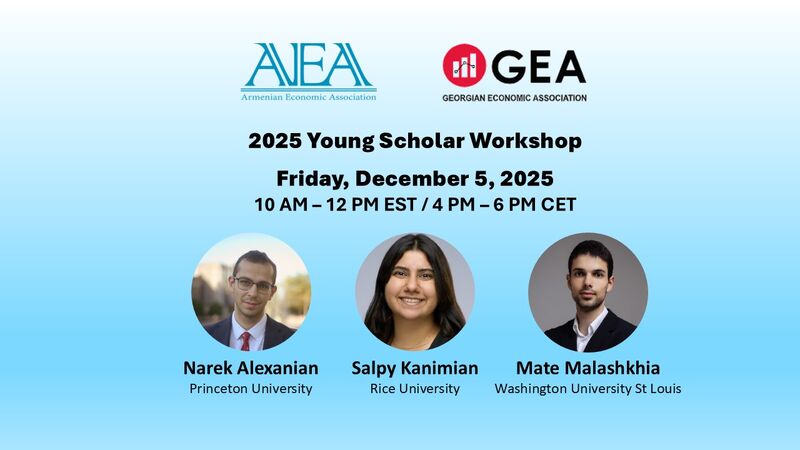

Narek is a Ph.D. candidate in the Department of Economics at Princeton University. His research explores how contractual choices affect business cycles and how heterogeneity interplays with non-Walrasian markets. In his job market paper, he examines how the degree of wage indexation to inflation influences macroeconomic dynamics and characterizes the transmission of monetary policy.
Job Market Paper: Endogenous Wage Indexation and Aggregate Supply
Abstract: Wage indexation—the extent to which wages adjust to unanticipated inflation—is widespread in labor contracts and can play an important role in shaping macroeconomic dynamics. I develop a model in which workers set hourly wages in the presence of productivity and nominal demand uncertainty, while firms optimally choose labor hours after shocks are realized. Wages can be made contingent on the realized price level, enabling workers to partially hedge volatility in real earnings and the disutility from work. While indexation allows real wages to absorb adverse supply shocks, it also exposes the economy to monetary disturbances. In equilibrium, I show that the optimal contract features nominal wages that adjust to inflation with an elasticity governed by the workers’ relative uncertainty about productivity and nominal shocks. As the latter dominate, wages become more indexed and the relative pass-through of monetary shocks to output weakens, which manifests as a steepening of the aggregate supply curve. Finally, price stabilization rules do not achieve output stabilization, as their impact is fully neutralized by an increase in the degree of wage indexation.

Salpy is a Ph.D. candidate in the Department of Economics at Rice University. Her research combines quasi-experimental methods with structural modeling to study the design and regulation of health insurance markets and structurally similar settings, such as workers’ compensation, that blend public oversight with private provision. Beyond her research, Salpy serves as an advisor to the Foundation for Armenian Science and Technology’s Generation AI program, a nationwide initiative that prepares the next generation to lead in emerging technologies.
Job Market Paper: Spatial Disparities, Selection, and Segmentation in Health Insurance
Abstract: Most U.S. means-tested programs use uniform eligibility thresholds that ignore regional cost-of-living differences. I study whether indexing eligibility to local costs improves coverage and targeting in Medicaid and health insurance marketplaces: two adjacent programs serving low-income individuals without employer insurance. I develop and estimate a model where the regulator sets eligibility rules, insurers compete on price and quality, and consumers choose or are assigned to plans. I find that adjusting eligibility thresholds for cost-of-living creates competing effects: it improves coverage by crowding low-income families into insurance in high-cost areas, but also reshuffles risk pools across both programs in ways that change premiums and plan quality. Counterfactual simulations using administrative data from California show that partial cost-of-living indexing yields higher welfare per public dollar than either uniform thresholds or full indexing. These results demonstrate how eligibility design interacts with market structure and insurer incentives in segmented health insurance systems.

Mate is a Ph.D. candidate at the Department of Economics at Washington University in St. Louis. His research lies at the intersection of Political Economy and Applied Theory, examining how institutional and political environments shape incentives, collective action, market outcomes, and welfare. Much of his work focuses on the political economy of non-democratic regimes, where he analyzes the strategic interactions among incumbents, challengers, citizens, external actors, and firms. The second strand of his research explores how political incentives shape citizen welfare when private markets are inefficient.
Job Market Paper: The Protest Dilemma: The Effect of Threat of War in Sustaining Non-Democratic Regimes
Abstract: In non-democratic regimes protests serve as the primary means of voicing political discontent. While a growing literature examines protests, the role of external factors remains underexplored. To fill this gap, we develop a formal model of how the enemy’s war decision and the incumbent’s use of propaganda influence citizens’ protest choices. We show that even when the incumbent is undesirable, the threat of war deters mobilization, offering a novel explanation for why grievances do not always translate into protest. Thus, protest outcomes depend critically on the circumstances faced by the enemy. Citizen mobilization under such conditions also hinges on the opposition being perceived as significantly more capable than the incumbent. Finally, when the adversary is more likely to invade if the opposition is expected to come to power, heightened war threat through propaganda can sometimes paradoxically fuel mobilization. Thus, propaganda is not a universally effective tool for protest suppression.